
The Face of Truth | Ibrahim Shaglawi Turning Off the Airport Lights..!
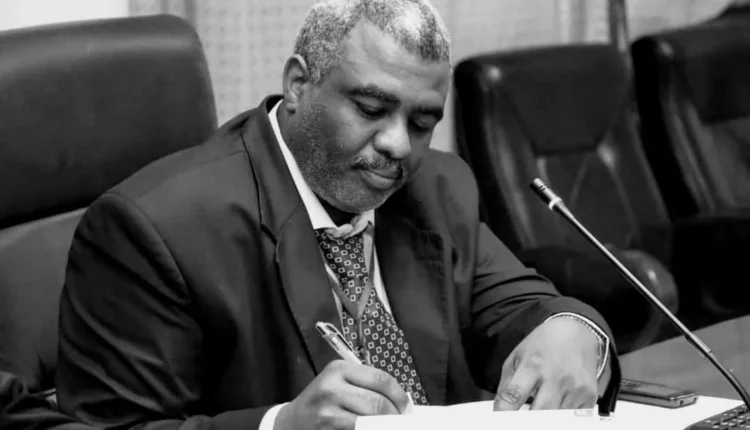
After three years of a war driven by regional and international ambitions—during which my family endured random shelling and the rhythm of daily tragedies in Omdurman—I chose to take them on an exceptional journey to the Kingdom of Saudi Arabia to perform Umrah, spend Ramadan and Eid al-Fitr, and share the joy of the birth of my second granddaughter. Throughout the trip, I continued writing regularly, except during the days of Eid.
The journey became a revealing experience of two worlds: one that carefully constructs order and places the human being at its center, and another governed by chaos even in the simplest details—including Port Sudan International Airport, which has become a testament to the government’s inability.
The journey began as a reward for the family and ended as a window for observation and political analysis, exposing the fragility of the state after the war and illuminating possible paths to recovery through reforming administrative behavior, strategic planning, and effective governance.
As soon as we set out from Omdurman to Port Sudan, the depth of the crisis became apparent: booking buses is complicated, intermediaries are multiplying, road levies are endless, and sharp price disparities burden citizens and force them into alternatives to escape the greed of brokers. This daily disorder is nothing but a reflection of a governance crisis: absence of planning, weak oversight, and a painful decline in service institutions.
Upon arrival at Dammam Airport in Saudi Arabia, the full picture emerges: smooth procedures, clear pathways, warm reception, and organized passenger flow—all reflecting a different state philosophy: a state that creates order, transforms human complexity into precise management, and places people at the forefront of its priorities.
Outside the airport, the image deepens further. Administrative organization is a public culture. Markets are not driven solely by profit but by a competitive system that lowers prices and gives consumers real choices. Even the religious experience in Mecca and Medina is no longer merely a ritual to be performed, but an integrated experience managed with the highest levels of precision and discipline, where crowd management and organization have become a science in their own right, balancing spirituality with efficiency.
This difference extends beyond daily services to the management of regional risks. Amid the Iranian-American conflict, the Kingdom maintained control over reactions with a calm mindset, through precise warning systems via mobile messages to citizens and continuous management of situations—reflecting high institutional capacity and a clear commitment to the safety of people, whether citizens or residents.
This system is not accidental but the product of a clear strategic vision for development—Saudi Vision 2030—through which public services and institutional efficiency are managed to meet daily needs, alongside the continuous building of trust between the state and society.
This contrast reveals that our country’s crisis is not only in the deterioration of services after the war, but in the fragility of service structures and state behavior. The war did not create chaos; it exposed the state’s weakness, the absence of strategic planning, and reliance on individuals rather than institutions, and on reaction rather than initiative.
The comparison reveals the depth of our crisis: the war did not bring down the state but exposed its fragility. Administrative dysfunction existed before the war, but it has become more visible afterward. Upon our return to Port Sudan Airport, this reality condensed into a painful scene: congestion, broken baggage belts, complex customs procedures, long unexplained waiting times—then, with striking indifference, an employee asked us to leave the hall because he was about to turn off the lights.
This transforms a daily inconvenience into a deeper crisis: a state absent from its role, leaving space for chaos and failing to manage even the simplest aspects of people’s lives.
The disorder goes beyond organization into the economy of services, where baggage carts are treated as private property and arbitrary fees are imposed on travelers. Here, the crisis of the Sudanese state becomes clear in three intertwined dimensions: the erosion of the meaning of the state, the decay of administrative behavior, and the fragility of institutional structures.
Rising from this nightmare cannot be achieved through partial reform; it requires comprehensive re-foundation. The starting point is reforming the civil service to become the backbone of the state. The role of the employee must be redefined, linking performance to accountability, and transforming the job from a privilege into a responsibility.
In parallel, precise strategic planning is required—one that turns national priorities into measurable, executable goals within defined timelines to regain control over time and resources. Effective governance is indispensable to ensure transparency, activate oversight, and prevent the accumulation of small dysfunctions into chronic crises—through digitizing services, ensuring the independence of auditing bodies, and making information accessible to the public.
In conclusion, according to #The_Face_of_Truth, this article is not about an airport or a journey, but about a deep reading of the crisis of the Sudanese state after the war, and a roadmap for recovery that begins with the human being, continues with sound planning, and ends with clear and effective governance—restoring the state to its natural role in serving its people.
Wishing you health and well-being.
Saturday, March 28, 2026
Shglawi55@gmail.com